Hand Held devices
1979 Block Buster
Going as far back as 37 years ago, the very first handheld gaming device ever made, is the Microvision Blockbuster, designed by Jay smith in 1973. This handheld gaming device also had exchangeable cartridges that were built into the screen of the device. Players would pull out the screen and change it in order to play a different game on the device. Despite it being incredibly large and hard to carry around, it was a revolutionary make at the time.

The Microvisions combination of portability and cartridge based system led to moderate success, with Smith Engineering grossing $15 million in the first year of the system's release. However, very few cartridges, a small screen, and a lack of support from established home video game companies led to its demise in 1981.
In this video you can see exactly how big in scale the blockbuster works and how it functions.
1984 Epoch Game pocket computer
The Epoch Game Pocket Computer is a handheld gaming console released by Epoch in Japan in 1984. It was one of the very few truly handheld systems to be released in the early 1980's, preceding the Game Boy by 5 years.

The Game boy
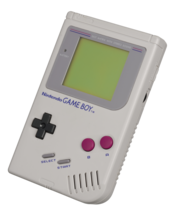
In 1989, Nintendo introduced their first hand held gaming device known as the Game boy. This revolutionary device sold thousands to many people world wide. It managed to play different games using cartridges such as Super Mario land, Pokemon gold and silver, Pac-man and many more. The picture on the left is the original Gamboy, the picture on the right shows the Gamboy Advanced, that was released many years later as an upgrade in graphics and games performance from the original, with a stylish more slick design change.

Atari Lynx / Lynx II - 1989
The Atari Lynx is next on my list, it was the second Atari console to be created after the Atari. Considered the only gaming device that ever challenged the game boy. Co-developed with Epyx and released in 1989. This console had much better better graphics than the Game boy, and if not for its expense it would've sold more too. Due to the fact that the Gamboy was much cheaper and already adored by many, more people proffered to buy the Gameboy than the Atari Lynx

Sega Game Gear - 1990
The next best thing that challenged the Gameboy after the lynx and the Turbo Express, is the Sega Game Gear, which also had a color screen. Not only did it have an advantage over the others in terms of best games wanted at the time and graphics, it also managed to keep its retail price at a low/cheap £120
Game Boy Color - 1998
In 1998, Nintendo brought it back with a complete color redesign, the Gameboy color. Now backwards compatible the Gameboy color was a must buy at the time as it could play it vast variety of games from the old hand held consoles to the new colored ones with better graphics capabilities as well. While this system was very successful, it was not Nintendo biggest project at the time.
Game Boy Advance / Advance SP / Micro - 2001 / 2003 / 2005
In 2001, Nintendo released its biggest one of the greatest if not, THE greatest hand held gaming device to exist at the time, The Game Boy Advanced. This legendary portable gaming system sold wildly across many nations, selling 81.51 million units worldwide. What made the Game boy so addictive and successful was its capabilities to play games in color, with fast, cleaner and more powerful graphics. With each three redesigns from the Mirco to the SP, the system could play every single backwards game from the old Gameboys with better graphics, while also having a selection of the newest games. This made the console and excellent machine for gaming, as it was basically a rough version of the super Nintendo making ports from that console easy, including games like Space wars.
In 2003, the SP was released, which was slightly different to the original, as it had a lit up screen, which was one of the main problems of the original. It also had a dedicated fold screen at the front top of the console.
This video shows the evolution of Gamboy technology and design over a span of almost 30 years
Television Gaming
- A way of accessing games through your television set
- Via subscription, gain access to small arcade like games
- All data and software stored in TV
- Works through cable and satellite signal only
- Only device needed for control is TV remote
- Games are very bland and generic
Despite the games being very primitive and not as mainstream as others, they do have advantages such as decently well crafted graphics. On top of good graphics, it also doesn't require any installation as its a direct play from the gaming TV games center.
Arcade
In the 70s and the 80s, Games developers invested in arcade machinery for games. They placed multiple Arcade boxes in different locations and made plug in only. These arcades used coins to function, making it easy for kids to play games, using a simple financial transaction method. Because of this, there was a massive coin shortage in japan in 1978.
Consoles
From the 80s onward to the 2000s, businesses sold games through their consoles, sold through retail outlets, back in the day it was this system was very lucrative; if you didn't own a console then you wouldn't be able to play certain games at all, even though console games were the most popular games back in the day. This meant that developers could not create games that couldn't be played on a Microsoft, Nintendo or Sony device. Computer Games were also popular but because of the lac of users and computer developers they did not sell as well. As a result, in 2001 Sony and Nintendo became the dominant companies.
Playstation
9 Sep 1995
The PlayStation was the first of the PlayStation series of console and handheld game devices, which was first created and released in Japan.

Nintendo 64
29 Sep 1996
The N64 was released with two launch games, Super Mario and Pilotwings , The N64's suggested retail price was US $199 at its launch and it was later marketed with the slogan Get N, or Get Out!.

PlayStation 2
26 Oct 2000
The PlayStation 2 is a sixth-generation video game console manufactured by Sony. The successor to the PlayStation, and the predecessor to the PlayStation 3, the PlayStation 2 forms part of the PlayStation series of video game consoles. Its development was announced in March 1999 and it was released a year later in Japan.

Xbox
15 Nov 2001
Microsoft makes it first independent foray into the console market with the release the of Xbox. The company's use of PC technology in the Xbox console allowed for better performance than the PS2. Xbox's greatest success proves to be Halo: Combat Evolved.

GameCube
18 Nov 2001
The Nintendo GameCube was the first Nintendo console to use optical discs as its primary storage medium, after several aborted projects from Nintendo and its partners to utilize optical-based storage media.

Xbox 360
22 Nov 2005
The console sold out completely upon release in all regions except in Japan. Several major features of the Xbox 360 are its integrated Xbox Live service that allows players to compete online, download arcade games, game demos, trailers, TV shows, music and movies and its Windows Media Centre multimedia capabilities. The Xbox Live also offers region specific access to third-party media streaming application such as Netflix and ESPN in the US or Sky Go in the UK.

PlayStation 3
17 Nov 2006
Major features of the console include its unified online gaming service, the PlayStation Network, its multimedia capabilities, connectivity with the PlayStation Portable, and its use of the Blu-ray Disc as its primary storage medium.

Wii
19 Nov 2006
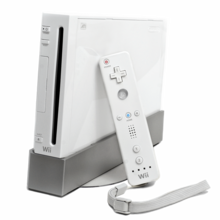
As a seventh-generation console, the Wii primarily competes with Microsoft's Xbox 360 and Sony's PlayStation 3. A distinguishing feature of the console is its wireless controller, the Wii Remote, which can be used as a handheld pointing device and detects movement in three dimensions. Another distinctive feature of the console is WiiConnect24, which enables it to receive messages and updates over the Internet while in standby mode.
PlayStation Move
17 Sep 2010
PlayStation Move is a motion-sensing game controller platform for the PlayStation 3 (PS3) video game console by Sony Computer Entertainment (SCE). Based around a handheld motion controller wand, PlayStation Move uses the PlayStation Eye camera to track the wand's position, and inertial sensors in the wand to detect its motion.

Xbox Kinect
4 Nov 2010
Kinect is a motion sensing input device by Microsoft for the Xbox 360 and Windows PCs. Based around a webcam-style add-on peripheral for the Xbox 360 console, it enables users to control and interact with the Xbox 360 without the need to touch a game controller, by using gestures and spoken commands. The project is aimed at broadening the Xbox 360's audience beyond its typical gamer base.

November 18, 2012
Wii U, the supposed successor to the original Wii, was a very big disappointment on release, as it did not do as well as it was intended. It was basically another Wii but with improved graphics and HD capabilities, but what brought it down was Nintendo's poor attempt to feel like a next Gen console.
In the 70s and the 80s, Games developers invested in arcade machinery for games. They placed multiple Arcade boxes in different locations and made plug in only. These arcades used coins to function, making it easy for kids to play games, using a simple financial transaction method. Because of this, there was a massive coin shortage in japan in 1978.
 1972
1972June 27, 1972
Atari Incorporated – Co-founders Nolan Bushnell and Ted Dabney embark on their new venture. Their first engineer hired was Allan Alcorn who designed Pong as simply a test, but it turned out to be the company’s first shipped product.November 30, 1972
First production Pong arcades begin to ship. Selling at just $1095, Pong began to sell to distributors and dealers to begin showing up in Bars, bowling alley’s and even in Mall’s and JC Penny’s.1973
To break the exclusive deals with distributors, Atari secretly creates its own competitor – Kee Games, run by Nolan Bushnell’s neighbor – Joe Keenan and headed by Steve Bristow as its lead engineer, Kee Games begins selling knock offs of Atari games, but with unique enhancements.November 1974
Kee Games releases its first unique game – Tank.This was the first coin-op game to contain ROM based code for its graphics. It was an instant hit seller and immediately saw a follow up – Tank II that same year. Tank is a very important game to Atari as later on it would become the basis for Atari Combat, which was the pack-in game included with the Atari 2600 video game console in 1977.December 1975Pong comes home.Sears Roebuck approaches Atari to sell video games in its Sporting Goods Department. Atari designs a home TV version of its Pong Arcade, originally looking to sell 50,000 units, Sears wants Atari to produce 150,000 of the Home Pong branded as Sears Telegames Pong. Atari would also sell 50,000 of its own Atari branded Atari Pong units. Sporting color, on screen score and audio from a built in speaker inside of the oddly shaped pedestal console, it turns out to be one of the hottest selling items for the 1975 holiday shopping season with people waiting several hours in line to purchase.May 13, 1976
Atari Breakout is released. This unique game has been called “Pong turned on its side” – basically it was a video game version of the very popular Racquetball game of the era. The concept was created by Nolan Bushnell and Steve Bristow. Looking to increase profits, the game circuit design was given to a young Atari engineer named Steve Jobs. Steve would come back and deliver a PC board design that reduced 50 chips from the cost, giving Steve Jobs a $5,000 bonus. However it would later be revealed that it was Steve Wozniak, while coming in during the middle of the night to play arcade games after work from Hewlett Packard who in fact designed the Breakout board. The board, while working and saving a great deal of cost was not usable in production, so it would have to be redone. The two Steve’s would move on and later found a computer company many might have heard of… Apple, Inc.October 1977
The Atari Video Computer System (2600) model #2600 makes its debut. With a retail price of $199-$229, the system is a multiprocessor based, programmable game console. It includes 2 joysticks and 2 paddle controllers. It comes with a 2 player game with 27 variations called Combat. Expected to have a library of 10 different games based on Atari arcade games, the console design is hoped to have a selling life of 2-3 years.December 1978
Atari Announces its formed a new Home Computer Division. The Home Computer and Consumer Electronic divisions are kept separate from one another. January 1979Atari’s marketing decides to try something new – to sell video games all year long and not push only for the holiday shopping season. At the Winter Consumer Electronics show in Atari officially debuts its Atari 400 and Atari 800 Home computers.
Summer 1979
Meanwhile Atari releases Lunar Lander into the arcades.October 1979
Atari 400 and Atari 800 home computers are officially released.November 1979
Atari’s answer to the quarter eating arcade hit Space Invaders arrives – called Asteroids, this arcade game will become one of Atari’s best selling and most memorable Atari smash hits.*December 1979
Selling Atari 2600 units all year round proves to be a major marketing move for Atari, and a profitable one as well. Selling nearly 400,000 units in 1979, Atari sells over $200 million in inventory for a net profit of almost $20 million…. Bigger sales and even bigger profits are ahead.January 1980
Atari’s first licensed title for its 2600 game console is released… Space Invaders.June 1980
Atari releases Missile Command into the arcades. Originally titled Armageddon, its game play reflected the Cold War nuclear attack scenario of the era. The designer of the game would only do it if the game was a defensive game and not an attack game.
Games Console Comparison Table
|
|
 |
 |
 |
|
Year of Introduction and
Generation
|
The PS4 was first introduced in November the 15th 2013.
The very first “next Gen” console to come out for its time. By
the end of 2013, the PS4 was launched in more European, Asian and South
American countries The PS4 released in Japan at ¥39,980 on February 22, 2014.
The PS4 is part of the 8th Generation
|
The new
Xbox has been unveiled at E3 2016 and leaks have revealed
it will be a thinner and more powerful version of the Xbox One. Here's everything you need to know about the
new Xbox One S including release date, price and specs. We also have details
on Project Scorpio which will be the new 4K Xbox for 2017 and Xbox Play
Anywhere, which is great news for Windows 10 users.
|
The Wii was released in November 19th 2006. The Wiis
release brought about a great change in the market as it was the main focus
for all family games and gamers.
|
|
Processing
|
The PS4 CPU remained clocked at 1.6GHz and contains a
similar custom AMD 8-core CPU with x86 based architecture. This represents
a roughly 10% increase in processing power for Xbox One, but the opposite is
true when it comes to the all-important graphics processor.
|
8GB DDR3 Clock: 2133MHz Bandwidth: 68.26 GB/s + 32MB eSRAM
Bandwidth: 204 GB/s(102 In/102 Out) [3
8GB Flash Memory [4]
8 Core AMD custom CPU Frequency: 1.75 GHz [5]
Clock Speed: 853 MHz(originally 800 MHz) Shader Cores: 768
Peak Throughput: 1.31 TFLOPS [6]
|
IBM PowerPC "Broadway" 729 MHz (unconfirmed) Broadway is the
codename of the 32-bit Central
Processing Unit (CPU) used in Nintendo's Wii video game console. It was designed by IBM, and is currently being produced using a 65 nm SOI process.
|
|
RAM
|
PS4 specifications. Inside, the PS4 is all business. It has
a custom single-chip processor that combines an eight core x86-64 AMD
"Jaguar" CPU with a 1.84 teraflop GPU based on AMD's Radeon tech.
That's backed by 8GB of mega-fastGDDR5 RAM, and a
500GB mechanical hard drive.
|
8GB DDR3 Clock: 2133MHz Bandwidth: 68.26 GB/s + 32MB eSRAM
Bandwidth: 204 GB/s(102 In/102 Out) [3
8GB Flash Memory [4]
8 Core AMD custom CPU Frequency: 1.75 GHz [5]
Clock Speed: 853 MHz(originally 800 MHz) Shader Cores: 768
Peak Throughput: 1.31 TFLOPS [6]
|
512 MB Internal flash memory SD card, SDHC card Nintendo
GameCube Memory Card
|
|
Graphics
|
PS4 specifications. Inside, the PS4 is all business. It has
a custom single-chip processor that combines an eight core x86-64 AMD
"Jaguar" CPU with a 1.84 teraflop GPU based on AMD's Radeon tech.
That's backed by 8GB of mega-fastGDDR5 RAM, and a
500GB mechanical hard drive.
|
8GB DDR3 Clock: 2133MHz Bandwidth: 68.26 GB/s + 32MB eSRAM
Bandwidth: 204 GB/s(102 In/102 Out) [3
8GB Flash Memory [4]
8 Core AMD custom CPU Frequency: 1.75 GHz [5]
Clock Speed: 853 MHz(originally 800 MHz) Shader Cores: 768
Peak Throughput: 1.31 TFLOPS [6]
|
ATI "Hollywood" 243 MHz (unconfirmed)
|
|
Storage Media
|
Use this function to copy the data saved on your PS4™ system onto a USB storage device. The name of
the backup data file is automatically set with the date and the order it was
saved. You can add notes in [Description]. FAT or exFAT formatted USBstorage devices are supported.
|
|
|
|
Connectivity
|
|
|
|
|
Target Audience
|
The PS4 targets many different type of people, as the games range
from children aged 7-12 games, to mostly 16+ games. Despite the different
games, the ps4 is definitely a more mature gaming machine designed for
hard-core and casual gamers, with games such as COD Black ops, Deus X,
Assassins creed, destiny and so more.
|
Xbox games are mostly targeted to hard core gamers who consistently
play games on a casual or on a competitive level. As they don’t release a lot
of family of kids games anymore. For example, they have games like Halo, COD,
Titan Fall ect ect
|
The Wii greatly targeted younger audiences with almost every game
they released. Such as all the Mario games, sonic games, Wii sports and so
more. All of which were usually family games too, designed for a party of 4
players with 4 Wii remotes all playing a party style game, such a Mario
Party.
|
|
Other features (eg all
round entertainment )
|
|
|
|
Consoles
From the 80s onward to the 2000s, businesses sold games through their consoles, sold through retail outlets, back in the day it was this system was very lucrative; if you didn't own a console then you wouldn't be able to play certain games at all, even though console games were the most popular games back in the day. This meant that developers could not create games that couldn't be played on a Microsoft, Nintendo or Sony device. Computer Games were also popular but because of the lac of users and computer developers they did not sell as well. As a result, in 2001 Sony and Nintendo became the dominant companies.
Playstation
9 Sep 1995
The PlayStation was the first of the PlayStation series of console and handheld game devices, which was first created and released in Japan.
Nintendo 64
29 Sep 1996
The N64 was released with two launch games, Super Mario and Pilotwings , The N64's suggested retail price was US $199 at its launch and it was later marketed with the slogan Get N, or Get Out!.
PlayStation 2
26 Oct 2000
The PlayStation 2 is a sixth-generation video game console manufactured by Sony. The successor to the PlayStation, and the predecessor to the PlayStation 3, the PlayStation 2 forms part of the PlayStation series of video game consoles. Its development was announced in March 1999 and it was released a year later in Japan.
Xbox
15 Nov 2001
Microsoft makes it first independent foray into the console market with the release the of Xbox. The company's use of PC technology in the Xbox console allowed for better performance than the PS2. Xbox's greatest success proves to be Halo: Combat Evolved.
GameCube
18 Nov 2001
The Nintendo GameCube was the first Nintendo console to use optical discs as its primary storage medium, after several aborted projects from Nintendo and its partners to utilize optical-based storage media.
Xbox 360
22 Nov 2005
The console sold out completely upon release in all regions except in Japan. Several major features of the Xbox 360 are its integrated Xbox Live service that allows players to compete online, download arcade games, game demos, trailers, TV shows, music and movies and its Windows Media Centre multimedia capabilities. The Xbox Live also offers region specific access to third-party media streaming application such as Netflix and ESPN in the US or Sky Go in the UK.
PlayStation 3
17 Nov 2006
Major features of the console include its unified online gaming service, the PlayStation Network, its multimedia capabilities, connectivity with the PlayStation Portable, and its use of the Blu-ray Disc as its primary storage medium.
Wii
19 Nov 2006
As a seventh-generation console, the Wii primarily competes with Microsoft's Xbox 360 and Sony's PlayStation 3. A distinguishing feature of the console is its wireless controller, the Wii Remote, which can be used as a handheld pointing device and detects movement in three dimensions. Another distinctive feature of the console is WiiConnect24, which enables it to receive messages and updates over the Internet while in standby mode.
PlayStation Move
17 Sep 2010
PlayStation Move is a motion-sensing game controller platform for the PlayStation 3 (PS3) video game console by Sony Computer Entertainment (SCE). Based around a handheld motion controller wand, PlayStation Move uses the PlayStation Eye camera to track the wand's position, and inertial sensors in the wand to detect its motion.
Xbox Kinect
4 Nov 2010
Kinect is a motion sensing input device by Microsoft for the Xbox 360 and Windows PCs. Based around a webcam-style add-on peripheral for the Xbox 360 console, it enables users to control and interact with the Xbox 360 without the need to touch a game controller, by using gestures and spoken commands. The project is aimed at broadening the Xbox 360's audience beyond its typical gamer base.
November 18, 2012
Wii U, the supposed successor to the original Wii, was a very big disappointment on release, as it did not do as well as it was intended. It was basically another Wii but with improved graphics and HD capabilities, but what brought it down was Nintendo's poor attempt to feel like a next Gen console.
|
Technology:
|
Reference:
|
Description & Why Important to
Gaming:
|
Image:
|
|
Human Computer Interface
|
|
|
|
|
Central Processing Unit (CPU)
|
CPU (pronounced
as separate letters) is the abbreviation for central processing unit.
Sometimes referred to simply as the central processor, but more commonly
called processor, the CPU is the brains of the computer where
most calculations take place
|
CPU are very impressive and very fast, they are important In gaming
as they are the central controlling system of everything in a device, they
control all the instructions given to all the other interacting devices such
as RAM and cache.
|
|
|
Graphics Processors (GPU)
|
Definition of: GPU. ... (Graphics
Processing Unit) A programmable logic chip (processor) specialized for
display functions. The GPU renders images, animations and video
for the computer's screen. GPUs are located on plug-in cards, in a
chipset on the motherboard or in the same chip as the CPU (see diagram
below).
|
The GPU is the most important part of a gaming device
as it runs incredibly fast and works with the CPU, although it just renders
images and connects to the mother board.
|
|
|
Memory (RAM)
|
|
|
|
|
Display
|
|
|
|
|
Sound
|
|
|
|
|
Game Storage Media
|
|
|
|
|
Interface Devices
|
|
|
|
|
Connectivity
|
|
|
|
|
Power Supply (PSU)
|
|
|
|

No comments:
Post a Comment